Indonesia’s cold chain logistics market is on a strong growth trajectory, projected to reach USD 12.59 billion by 2031, representing a 10.2% CAGR. Growing demand for food & beverage, meat, fish and seafood, pharmaceuticals, and other temperature-sensitive products is driving the need for reliable cold storage, refrigerated transportation, and integrated distribution solutions.
The market is also evolving through digitalization, advanced refrigeration technology, expanding refrigerated warehouse capacity, and the growing adoption of more efficient cold chain solutions. Cold storage currently represents the largest segment, while cold chain transportation is expected to grow faster, with a projected 12.7% CAGR through 2031. These developments create increasing opportunities across the entire temperature-controlled supply chain — from storage and transportation to monitoring, distribution, and last-mile delivery.
With the continued development of Indonesia’s food, fisheries, pharmaceutical, healthcare, retail, and logistics sectors, investment in cold storage infrastructure, refrigeration systems, reefer transportation, warehouse automation, temperature monitoring, sustainable cooling, and specialized logistics services is expected to remain an important opportunity. The World Bank also highlights cold chain as critical for food preservation, reducing food loss, supporting
reliable access to temperature-sensitive medicines, and strengthening food and health supply chains.
COLDCHAIN & LOGISTICS INDONESIA 2027 provides a dedicated platform for businesses and industry leaders to connect, discover new technologies, and build the infrastructure required for Indonesia’s next generation of temperature-controlled supply chains.
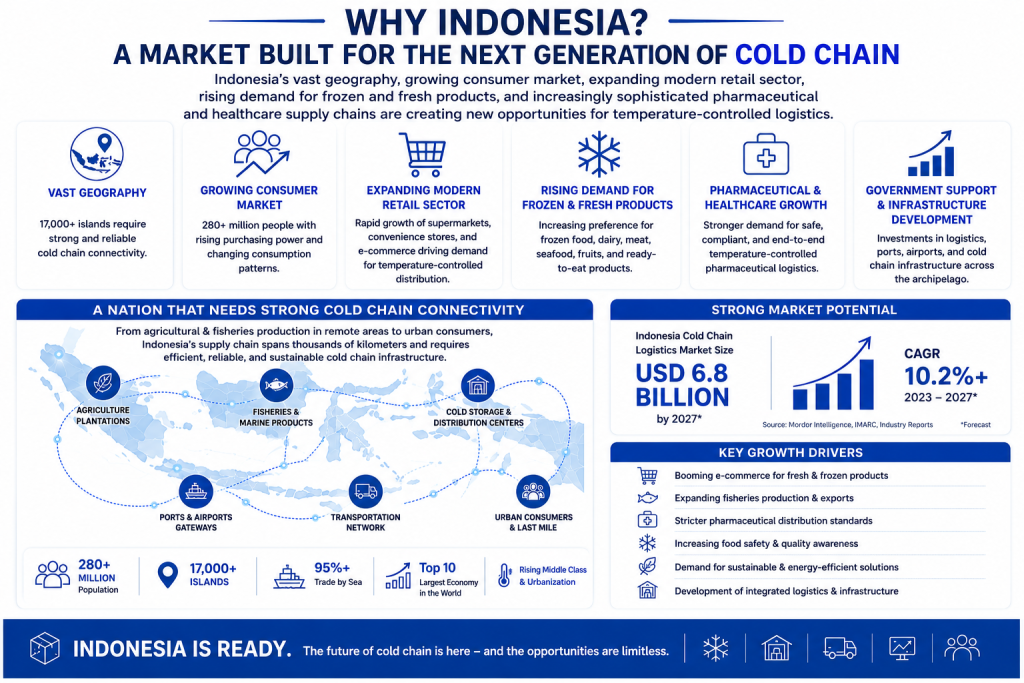
WHY INDONESIA?
A MARKET BUILT FOR THE NEXT GENERATION OF COLD CHAIN
Indonesia’s vast geography, growing consumer market, expanding modern retail sector, rising demand for frozen and fresh products, and increasingly sophisticated pharmaceutical and healthcare supply chains are creating new opportunities for temperature-controlled logistics.
With thousands of islands and a supply chain that stretches from agricultural and fisheries production to urban consumers, Indonesia requires efficient and reliable cold chain infrastructure.